 Skip to content


Sometimes, a form field should only appear when other fields meet specific criteria.
This seemingly simple requirement sits at the heart of most non-trivial forms: applications, registrations, compliance workflows, onboarding flows, and lead qualification processes. As soon as a form needs to adapt to user input, conditional logic becomes unavoidable.
Yet, despite how common this need is, conditional logic remains one of the most misunderstood — and poorly implemented — aspects of WordPress form builders.
The Current State of Conditional Fields in WordPress
Most WordPress form plugins either:
- Do not support conditional logic natively, requiring add-ons, or
- Support only very basic conditions, limited to showing or hiding fields
At first glance, this seems sufficient. Fields appear when needed, disappear when not. The form feels dynamic. The user experience improves, right?
However, beneath the surface, many of these implementations undermine the very purpose of conditional logic — preventing irrelevant, contradictory, or premature inputs — and introduce subtle, sometimes serious problems:
- Fields hidden under certain conditions remain required
- Validation rules don’t adapt to the current state of the form
- Multiple valid user paths are collapsed into a single rigid rule set
- Data becomes inconsistent or incomplete without obvious errors
These are not edge cases. They are predictable outcomes of limited conditional logic models — and they often go unnoticed until data quality has already been compromised.
AND Logic Is Not Enough

Most conditional logic implementations rely on a single set of rules that must all be true for a field to be shown. This is logical conjunction — AND logic.
For example:
Show field X if
– Field A equals “Yes”
– AND Field B is not empty
This works — until a field should be valid under multiple independent scenarios.
Real-world forms often have branching logic. A field could be relevant if either condition A or condition B is met.
When a form system only supports a single conjunction of conditions, these scenarios become difficult — or impossible — to model correctly.
Developers are then forced to duplicate fields, add custom code, or accept incorrect behavior.
Logical Disjunction: Modeling Reality
SnapForms approaches conditional logic differently.
Instead of a single flat set of conditions, SnapForms introduces condition groups:
- Logical conjunction (AND) applies within a group
- Logical disjunction (OR) applies between groups
In other words:
A field becomes active if any group of conditions is satisfied
— and within each group, all rules must hold true

This distinction may seem academic, at first glance, but it fundamentally changes what can be expressed declaratively in a form.
Complex decision trees become explicit, readable, and maintainable — without custom development.
Logic Beyond Visibility
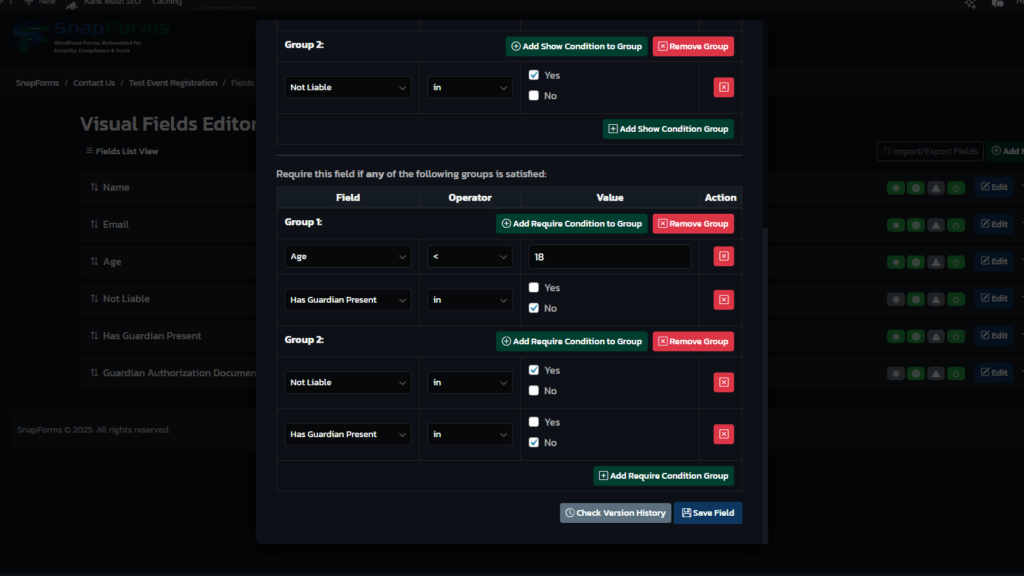
Most form builders treat conditional logic as a visibility-only feature, reducing a powerful decision model to a UI toggle — leaving core form semantics governed by static rules.
SnapForms deliberately goes further, applying the same conditional logic engine not just to field visibility, but also to requiredness. This means:
- A field becomes required only when its conditions are met
- When conditions are no longer met, the requirement is lifted
This approach dramatically improves workflows while reducing invalid submissions, support issues, and post-hoc data correction.
Fewer Workarounds, Fewer Bugs
By supporting both conjunctional and disjunctional logic — and applying it consistently across visibility and validation — SnapForms enables form configurations that would otherwise require custom code.
This provides:
- Higher flexibility without sacrificing correctness
- Lower implementation and maintenance costs
- Predictable behavior even as forms evolve
- Reduced risk of silent data corruption
The result is not just a “more dynamic” form — but a more reliable system.
Designed for Expansion, Not Hacks
Conditional logic in SnapForms is treated as a foundational architectural component, not as a shiny UI feature bolted on afterwards.
That same logical framework is already used to control multiple aspects of form behavior — and is designed to be extended in future releases to additional capabilities.
This ensures that as forms grow more complex, their behavior remains explainable, auditable, and correct.
Dynamic Forms, Without Compromising Integrity
Conditional fields are no longer optional. They are a necessity.
But without a proper logical model, they introduce fragility instead of flexibility.
By embracing the power of the combination of logical conjunction and disjunction — and by applying conditional logic to requiredness besides visibility — SnapForms ensures that dynamic forms remain correct, consistent, and trustworthy.
Forms should adapt to users — without compromising the integrity of the data they collect.
That is the standard SnapForms is built around.

Ready to improve your forms?
WordPress forms built for data integrity and privacy
SnapForms helps you reliably collect more valuable data — while fully respecting user privacy and security.
Still unsure? Register for the demo


