Skip to content


Why traffic analytics break at the moment of conversion
The online world has expanded into a wide variety of channels. From email newsletters, to social media, to blog articles, YouTube videos, online forums, or even AI-based chat tools — such as ChatGPT. This abundance of channels introduces a growing need for precise traffic source attribution.
Modern marketing is built on measurement. Campaigns are tagged, funnels are optimized, and budgets are shifted based on performance data and ROI. Yet, despite all this effort, attribution often breaks at the most critical moment: when a user actually converts.
In WordPress, this breakdown usually happens at the form layer.
Traffic analytics tell us how users arrive. Forms are where intent becomes action. When the two are disconnected, attribution becomes approximate at best — and misleading at worst.
❞
What gets measured gets managed
Peter Drucker
Management Consultant, Author

The Attribution Gap
Marketing teams invest significant effort into tracking acquisition channels: email campaigns, paid search, social media, referrals, content syndication, and more. UTM parameters, referrer headers, and platform-specific click identifiers are widely used to understand where visitors come from.
However, in many WordPress setups, this context disappears once a form is submitted.
Form submissions are often stored without any persistent attribution metadata. The result is a dataset that answers what was submitted — but not why, from where, or under which conditons.
This gap makes it difficult to answer basic but critical questions:
- Which campaign actually generated qualified leads?
- Which traffic sources convert — and which merely inflate page views?
- How do language, geography, or device affect form completion?
- Which channels justify continued investment?
Without attribution storage at the point of conversion, these questions remain pure speculation.
UTM Parameters: Needed, but Insufficient
UTM (Urchin Tracking Module) parameters remain one of the most reliable attribution mechanisms in a privacy-conscious web. As cookie-based tracking faces increasing regulatory and technical restrictions, UTM tags provide a transparent, first-party way to connect campaigns to outcomes.
There is a wide variety of UTM parameters, but the five most popular UTM tags are:
- utm_source — traffic origin (google, facebook, newsletter, etc.);
- utm_medium — channel type (cpc, email, social);
- utm_campaign — campaign identifier (e.g., black_friday, xmas_special, …);
- utm_term — paid keyword tracking;
- utm_content — variant or call-to-action differentiation.
While UTM tags may show which campaigns drive engagement, incomplete or improperly persisted usage creates a false sense of precision.
The limitation is not the tags themselves — it is where the data ends up.
When UTM data capture is delegated to analytics tools and is not linked to form submissions, attribution remains detached from the actual conversion event. The most critical moment in the whole process becomes analytically blind.
Attribution Is Contextual, Not Just Referential
Modern attribution requires more than a source label.
A campaign’s effectiveness is influenced by context — and context is multi-dimensional:
- Geographical location may affect eligibility, pricing, regulatory exposure or provide a glimpse into a potential new market.
- Primary language can influence understanding and conversion likelihood.
- Device type and operating system reveal usability constraints and friction.
- Referrer data provides insight beyond domains, including specific entry paths.
- Platform click identifiers (gclid, fbclid, msclkid) add granularity to paid traffic analysis.
When these signals are captured in isolation — or not captured at all — attribution becomes fragmented.
When they are preserved together, a coherent picture of user intent emerges.
Where Most WordPress Form Solutions Fall Short
Most WordPress form plugins treat attribution as an external concern.
They delegate attribution entirely to third-party analytics tools, while form submissions remain structurally unaware of their own context. This separation introduces several issues:
- Attribution data cannot be reliably tied to individual submissions.
- Privacy compliance becomes harder to ensure across systems.
- Analysts must try to correlate datasets manually, often imperfectly.
- Long-term analysis breaks when analytics configurations change.
In practice, this means that form data — often the most valuable data a site collects — is stored without the context needed to interpret it correctly.

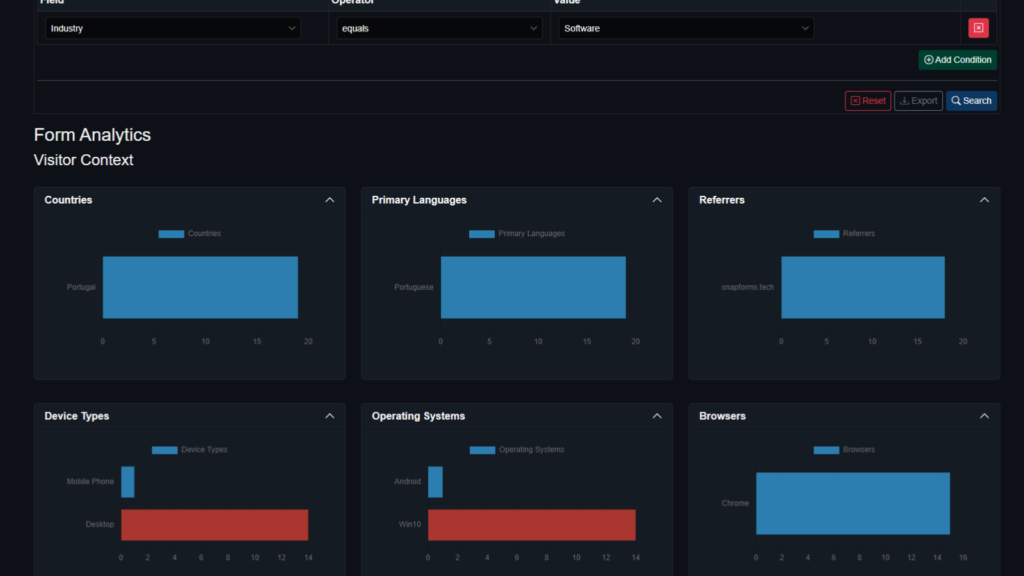
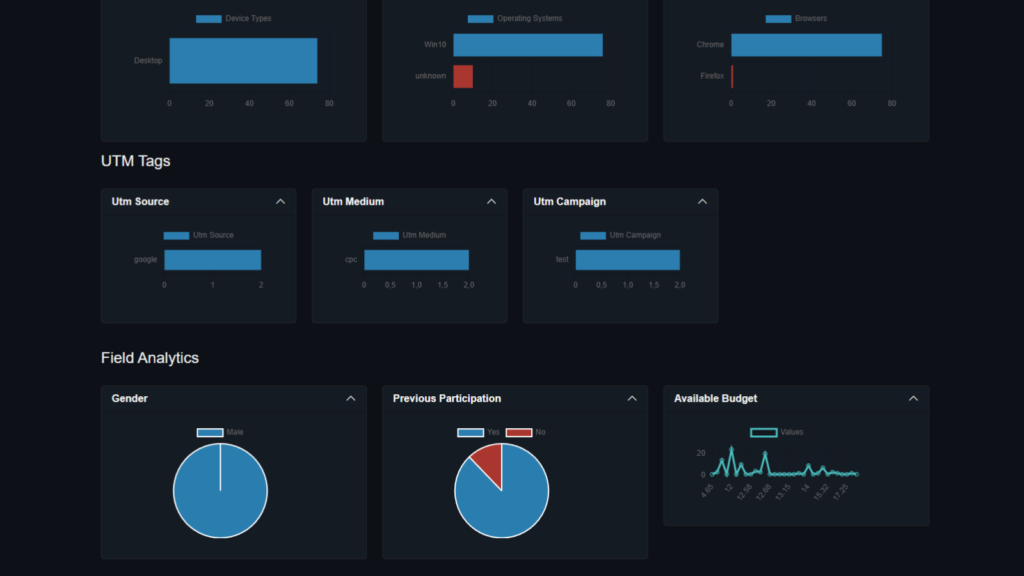
SnapForms: Treating Attribution as First-Class Data
SnapForms is designed to bridge this gap between form data and attribution.
Rather than treating attribution as an afterthought or external concern, SnapForms captures attribution data as part of the form submission itself. UTM parameters, referrer information, device metadata, language detection, and geo-location are persisted alongside the submitted fields.
This creates a direct and durable link between:
- How a user arrived
- What they submitted
- Under which conditions the conversion occurred
Because this data is stored within the form system, it remains accessible, auditable, and analyzable — independent of third-party analytics tooling.
From Data Collection to Decision-Making
Attribution data is only valuable if it can be explored and acted upon.
SnapForms provides built-in analytics and filtering capabilities that allow administrators to segment and analyze submissions by:
- Traffic source and campaign
- Device, operating system, and browser
- Country and language
- Referrer domain and page
- Platform-specific click identifiers
- Form field values themselves
Filters support multiple operators — including equality, containment, emptiness checks, and numerical comparisons — and can be applied both to analytics dashboards and submission lists.
All filtered views can be exported for deeper analysis, enabling teams to move from raw data to informed decisions without fragile workarounds.
Attribution Without Compromising Privacy
As privacy regulations continue to tighten, attribution strategies must adapt.
By relying on first-party data and avoiding unnecessary third-party dependencies, SnapForms enables attribution practices that are both insightful and compliant. Attribution becomes a matter of data architecture, not consent theater.
This aligns measurement with modern expectations of transparency, accountability, and data minimization.
Measuring What Actually Matters
Attribution should not end at page views or sessions. It should extend to the moment intent becomes action.
Forms are where that transition happens.
By preserving attribution context at the form level, SnapForms allows organizations to measure what truly matters — and to manage growth based on evidence rather than inference.
In an increasingly complex digital landscape, attribution is not just about tracking traffic. It is about understanding outcomes. And outcomes begin with forms.
If you’d also like to understand how SnapForms prevents data loss in evolving WordPress forms, you may read this article.

Ready to improve your forms?
WordPress forms built for data integrity and privacy
SnapForms helps you reliably collect more valuable data — while fully respecting user privacy and security.
Still unsure? Register for the demo